Google is expanding its smart home ecosystem by launching a full-stack Gemini AI offering that integrates advanced camera intelligence, natural language queries, and daily activity summaries. This initiative provides service providers and hardware manufacturers with turnkey reference designs and APIs to build proactive, branded services without extensive research and development. Ultimately, the program aims to move beyond basic device control toward an AI-native home that can understand context and care for users' needs in real time.
At Good Work Austin, our work is about nourishing the people who nourish our city. We believe the heart of our city lies in its food and beverage scene, but that it must be equitable and accessible. Our organization, in collaboration with a network of local restaurants, is fostering sustainable careers through professional development and advocacy.
Good Work Austin is dedicated to improving healthcare access, identifying healthy workplaces, and providing culinary training for those facing barriers to employment. Our Culinary Workforce Training program is a free nine-week course that helps students find a living-wage job in the food and beverage industry. Students learn culinary skills from some of the best chefs in Austin while receiving a stipend to support themselves for the duration of the program.
In partnership with GFiber, we identified a major, often overlooked barrier to employment: the digital divide. With job applications and information available mainly online, our students need internet access to get their foot in the door. Digital equity broadens employment opportunities, while our program provides the skills to get hired.
To bridge the digital divide, GFiber funded a pilot program to equip our students with Google Chromebooks, available for them to use throughout the program and keep after graduating. These laptops allow our students to fully participate in training, build digital literacy skills, and secure employment at the end of the program.
Access to technology is a critical barrier in workforce development, and these computers have been life changing. Brianna, one of our culinary trainees, shared her experience, “Instantly, I felt special. Like the community, businesses, donors, and GWA truly cared about us and our growth. I was already invested and motivated to do well in this program and elevate my life; to have others be as invested is a true gift. Thank you to all that contributed to providing us with laptops, especially GFiber.”
Looking forward, Good Work Austin aims to continue breaking down barriers to employment. We want our students to have economic mobility in the restaurant industry, and the ability to grow within their careers. Beyond culinary training, we’re working hard to expand free healthcare access, beginning with a focused pilot program.
By combining culinary skills with digital tools and essential healthcare, we’re building a foundation where economic mobility can become a reality. As we expand our reach and programs, Good Work Austin remains committed to a future where every worker in our industry has the resources, technology, and support they need to thrive both in and out of the kitchen.
If you or someone you know would like to learn more about Good Work Austin or apply for one of our programs, visit our website at www.goodworkaustin.org.
Posted by Kara Hanaoka, Executive Director of Good Work Austin
by Adrian Chung, Abdelfettah Sghiouar & Matt Larkin, Google Kubernetes Engine
Empowering every engineer to do more with Kubernetes
Kubernetes is the gold standard for container orchestration. Its power, flexibility, and rich API surface are exactly why it has become the foundation of modern cloud-first infrastructure. Today, engineers express that power through the K8s API, declarative YAML manifests, and cloud consoles, a remarkably expressive toolbox.
We believe the next step is to expand how engineers interact with that toolbox. A Kubernetes expert should be able to converse with a deep-domain peer that speaks fluent control-plane and can reason about cluster state in real time. An engineer who isn't a Kubernetes specialist should be able to express higher-order intent, such as "deploy my application," "rebalance this workload" and have it carried out safely against the same powerful APIs. Both audiences get more leverage out of the platform they already trust.
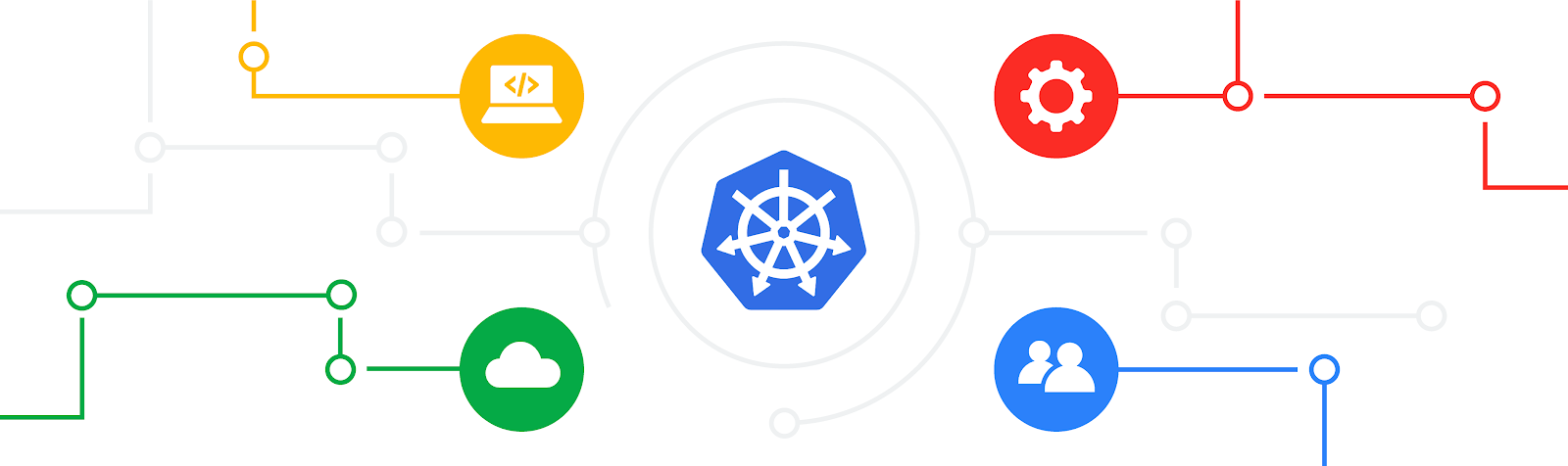
This is the vision behind Kube-Agents: a system of intelligent, autonomous, and human-in-the-loop agents that act as a new, intent-driven presentation layer for Kubernetes. We are moving from declarative intent via API to higher-order, human intent-driven operations while preserving everything that makes Kubernetes great underneath.
The Vision: Expanding the Presentation Layer
Today, engineers do impressive work stitching together metrics, alerts, and multi-step commands to keep clusters healthy. Agents extend that work, not replace it. By complementing existing interfaces with autonomous agents, engineers can choose the level of abstraction that fits the task: drop down to kubectl and YAML when precision matters, or describe intent in plain language when speed and clarity matter more. The agents continuously observe system state and can execute complex operations in real time on the engineer's behalf. This isn't about hiding Kubernetes. It's about giving every engineer a more capable collaborator on top of it.
Meet the Agents: A Specialized Team
Our architecture is currently built upon three core specialized agents, each acting as a new kind of intent-driven collaborator for different stakeholders:
The Platform Agent
Role: A partner for the central governance layer, your management plane.
Focus: Codifying best practices and keeping platform blueprints evergreen and synchronized across the entire fleet.
Example: When a new egress policy is defined at the org level, the Platform Agent propagates it to the Dev Team agents and confirms enforcement, giving platform teams confidence in compliance while letting developers stay focused on their applications.
The Cluster Operator Agent
Role: A trusted teammate for your infrastructure operators.
Focus: Global concerns like multi-cluster balancing, automated provisioning, security patching, and zero-downtime version upgrades.
Example: It can detect a degrading node and proactively migrate workloads before application latency spikes, expanding what a single operator can safely manage at scale.
The Development Team Agent
Role: A production-savvy peer for developers.
Focus: The primary collaborator for developers. It supports the full workload lifecycle — reconciling manifest drift, right-sizing resources, and assisting with real-time debugging.
Example: When a developer asks "Why is my service failing?" in chat, the agent responds with relevant logs, correlated metrics, and a diagnosis of recent config changes — meeting a Kubernetes expert at depth and meeting a less specialized developer at intent.
Leveraging Industry Benchmarks
DevOps Bench is a comprehensive suite of benchmarks. These specialized agents learn from those results so they are equipped with the context to make well-reasoned decisions when autonomously supporting infrastructure work.
The First Demo
To be truly useful at the presentation layer, these agents can't be short-lived request/response scripts. They need to be persistent, long-running "team members" capable of continuous learning and collaboration.
As a first step, we've launched a set of workspaces compatible with OpenClaw for a demo, installable into your OpenClaw environment, leveraging existing out-of-the-box capabilities around identity, storage persistence, and memory. The agents included are: the Platform Agent, the Cluster Operator Agent, and the Development Team Agent.
Autonomous GitOps & JIT Probing (Dev Team Agent): Demonstrates prompt-driven staging deployments and dynamically generated, context-aware probers. The agent adheres strictly to GitOps workflows by opening PRs for infrastructure updates (such as node failure tolerance) and actively prevents configuration drift by reconciling manual manifest edits upon merge.
Self-Healing Infrastructure (Dev Team Agent): Showcases automated troubleshooting when a manifest is deployed with an image name typo. The agent executes a complete, autonomous 5-step remediation loop—Notification, Learning, Recommendation, Mutation, and Validation—to detect, fix, and verify the deployment without human intervention.
Multi-Agent Governance & Policy Coordination (Cluster Operator & Dev Team Agents): Highlights cross-agent negotiation when the Cluster Operator attempts to downscale underutilized resources for cost savings. The Dev Team Agent steps in to enforce minimum capacity policies, successfully prioritizing application reliability and governance over financial savings.
Going forward, we will further productize this pattern, building on open standards to define agents and their capabilities (AGENTS.md, skills, MCP), and provide an out-of-the-box harness to orchestrate these agents.
Redefining the Stack
An intent-driven presentation layer is just the beginning. With an agentic interface in place, we can keep evolving the underlying infrastructure — adopting new components or integrating directly with additional infrastructure APIs — while engineers continue to interact with the system the way they already do. The interface stays intent-driven and stable; the agents adapt to the evolving stack underneath, so investment in how teams work today carries forward.
Call to Action
We're building Kube-Agents in the open because we believe the best infrastructure solutions are built collaboratively. Our goal is to use our expertise to give back to the open source community, while also actively learning from the ecosystem's real-world challenges. By working together, we can define best practices that benefit everyone.
If you're interested in helping shape the future of Kubernetes management, check out the Kube Agents repo.
We are seeking engagement on two fronts:
Share your use cases: What would you most like an autonomous teammate to help with? We want to learn from your unique operational needs—whether it's multi-cluster balancing, specific debugging scenarios, or policy enforcement—to ensure we're building tools that provide real leverage.
Define future roles: What new specialized agents should exist? We value your input on the roles these agents should fulfill to best serve diverse team structures and operational requirements.
Join the conversation, contribute your ideas, and help us build a self-driving cloud that works for everyone. Check out the Kube Agents project to open an issue or start a discussion.
At Google I/O, we introduced new ways for developers to expand their reach and scale their business with less complexity.We’re expanding their reach by meeting users whe…
The Dev channel has been updated to 150.0.7846.4 for Windows, Mac and Linux.
A partial list of changes is available in the Git log. Interested in switching release channels? Find out how. If you find a new issue, please let us know by filing a bug. The community help forum is also a great place to reach out for help or learn about common issues.
Hi everyone! We've just released Chrome Dev 150 (150.0.7847.2) for Android. It's now available on Google Play.
You can see a partial list of the changes in the Git log. For details on new features, check out the Chromium blog, and for details on web platform updates, check here.
If you find a new issue, please let us know by filing a bug.
We're excited to bring you a special bonus episode of Google’s Ads DevCast! We’re going over a few of the bigger announcements and updates from Google Marketing Live (GML) 2026 that directly affect our developers and technical users, across Tagging, Data Manager, and Meridian.
Tagging improvements: Discover the new Google tag gateway In-UI setup offerings (featuring GCP, Akamai, Cloudflare, and Fastly) and new CMS integrations. We also discuss Visual Tagging for troubleshooting purchase conversions, and how we are bringing GTM capabilities directly to the Google tag.
Data Manager API: Learn about the value of single ingestion and multi-feed, allowing you to flow first-party data to multiple Google products with a unified schema. We also touch on Confidential Matching for privacy-safe audience building.
Meridian (open-source MMM): Get an overview of the new Meridian offerings announced at GML, including Meridian in GA360, Meridian Studio (featuring native agentic capabilities), and Meridian GeoX for incrementality calibration.
Listen to the episode to get all the details and prepare for next week's deep dive into Meridian!
Don't forget to take our Episode Survey to let us know what you think!
Soccer is the most searched sport in the world, and U.S. fans’ passion is reaching new heights. To fuel that excitement, we’re partnering with the U.S. Men’s and Women’s…


 At Google I/O, we introduced new ways for developers to expand their reach and scale their business with less complexity.We’re expanding their reach by meeting users whe…
 The Texas Energy Impact Fund announced its first grant recipients from its $30 million commitment to energy efficiency in the Lone Star State.
 How a school division eliminated barriers for students by adopting Face control — an accessibility feature built into every Chromebook.


 Soccer is the most searched sport in the world, and U.S. fans’ passion is reaching new heights. To fuel that excitement, we’re partnering with the U.S. Men’s and Women’s…