Author Archives:

Why do internet promo deals cost more over time?

Thumbnail

Promotional pricing on internet service is designed to look like a great deal. It often isn't. Customers who choose a low introductory rate routinely pay more per month on average overall than customers who chose straightforward pricing from day one.

How promotional pricing works

Many major internet providers advertise a rate that applies only to new customers for some limited amount of time, typically 12 to 24 months. The promotional rate often appears in ads, mailers, and search results, and may not include taxes and fees. But, even if it’s a great price for that short period, the standard rate activates automatically when the promotional period ends. And, according to HighSpeedInternet.com, these standard rates can be up to more than $70 higher per month, and usually both the amount and the timing is tucked away in the fine print.

These rates can come with other requirements as well. Some providers bundle the promotional rate with a TV or phone package. The bundle lowers the apparent monthly cost, but the discount is temporary, and customers often continue paying for service they don't use long after the promotional period ends. Or they can represent guaranteed pricing like a multi-year price lock. Advertising like "your price won't change for 5 years" sounds reassuring. But these promotions frequently exclude equipment rental fees and broadcast TV surcharges. And of course, when the lock expires, standard rates apply.

Three promotions to watch out for

There are three common advertising approaches that some internet providers use to attract new customers, but it pays to read the fine print. 

  • Introductory rates. Advertisements often promise fast internet starting at a low monthly rate, but the asterisk usually leads to a "for 12 months" disclaimer. After that, the price jumps to the standard rate. When you add a monthly equipment rental fee and a one-time installation or activation charge, your average monthly cost climbs significantly.

  • Bundles. Bundle promotions reduce the individual price of each service only while the bundle remains active. When the promo ends, each component usually reverts to its standard rate. Customers who decide to drop TV from the bundle often discover that the internet-only rate is higher than what they were paying for the entire bundle before.


  • Price locks. A limited-time price lock can look competitive, but it’s important to read the fine print. Price locks typically exclude other essential fees like equipment and may only apply to select speeds. When the lock ends, the standard rate kicks in, often requiring customers to call customer service to negotiate a new discount.


Once the promotional period ends, the standard rate kicks in automatically, and customers pay a significantly higher price per month than what they signed up for.

But GFiber’s transparent pricing policy is designed so you always know exactly what you're going to pay. Our products are priced at a flat rate every month with no hidden fees. There are no expiring introductory rates to worry about, confusing bundles to manage, or price locks to negotiate. What you see when you sign up is what you can expect.

The GFiber difference: transparent, all-inclusive pricing

GFiber uses an all-inclusive pricing structure designed to remove any pricing uncertainty for our internet products. For example, the GFiber Core 1 Gig plan is $70 per month.[1] This straightforward rate includes professional installation and your Wi-Fi hardware (including router and up to extenders as needed[2]), with no promotional expiration dates, no data caps, and no unexpected rate hikes down the road. And that price hasn’t changed since we launched it in KC in 2012.

This commitment to a truly great customer experience is a primary reason why GFiber has been awarded #1 in Customer Satisfaction for Residential Wired Internet Service in the South Region by J.D. Power for three consecutive years.[4] Customers know exactly what they will pay every single month and never have to spend their valuable time negotiating with customer service over an unexpected increase on their bill.

The real cost of chasing a deal

The lowest advertised rate is rarely the lowest long-term cost. Introductory pricing, bundle discounts, and multi-year locks all share a compelling number up front and an inevitably higher number down the road. Coupled with the frustration of not realizing your bill went up, having to call to request the original price you signed up for, seeing new customers get a better deal than you, these lower priced deals are seldom worth it in the long run.

The internet is an essential monthly expense. That’s why our suite of lifestyle internet products is built around how you use the internet, like GFiber’s Core 1 Gig for $70. Every month. No negotiating required. Because with GFiber, the price you see when you sign up is exactly what you can expect month after month, year after year.


Footnotes and Disclaimers


  • [1] Pricing & Service: Upload/download speed and device streaming claims are based on maximum wired speeds. Actual internet speeds, Wi-Fi speeds, and Wi-Fi coverage are not guaranteed and can vary based on factors such as home or business size and layout, construction materials, hardware and software limitations, latency, packet loss, etc. Advertised prices do not include local access fees, which go back into your community, or taxes, both of which may be subject to increase. 

  • [2] Customers canceling service will have to pay a replacement fee (including any applicable taxes) if they fail to return equipment within 60 days after cancellation.

  • [3] J.D. Power Award: GFiber received the highest score in the South region of the J.D. Power 2023-2025 U.S. Residential Internet Service Provider Satisfaction Studies, which measures customers’ satisfaction of service with their current internet. Visit jdpower.com/awards for more details.

What makes GFiber’s fiber-optic infrastructure unique for high-speed internet?

Thumbnail

There are several ways to connect your home to the internet today, and each comes with its own set of performance standards. GFiber runs on an entirely fiber-optic network built to deliver high symmetrical speeds, low latency, and reliable performance directly to your home. Additionally, GFiber proactively improves network technology across active service areas to align with modern bandwidth demands.

Understanding internet connection types

Most households connect to the internet via fiber, cable, DSL, fixed wireless 5G, or satellite. The structural performance of these formats varies based on physics and network materials. Here’s how they break down:

  • Fiber-optic technology: Fiber carries data as pulses of light through glass. Fiber-optic technology allows signals to travel faster than electrical currents. Fiber networks run fiber-optic cable from a central facility directly to your home.

  • Cable internet infrastructure: Cable usually runs on hybrid fiber-coaxial (HFC) networks. While fiber may carry data to a neighborhood node, coaxial cable handles the final leg of the journey to the home and uses copper cable and electrical signals

  • DSL networks: DSL uses traditional copper telephone lines. Because of the limitations of copper, signal quality and speed often drop the further you are from the provider’s central office.

  • Fixed wireless 5G: Fixed wireless 5G connects homes using the same radio spectrum as mobile cellphone networks. Data travels from nearby cell towers to a receiver installed at your home.

  • Satellite infrastructure: Satellite uses radio waves beamed from space to a home dish. While satellite reaches remote areas, weather can affect signal quality and offered speeds are often lower.

Which internet connection is right for you?

Selecting an internet format depends on your specific performance needs and local network availability. For those on the fence about which type of internet would work best for them, it’s worth noting that according to an editorial analysis from CNET, "Google Fiber raises the bar for fiber internet service."[1]

Additionally, CNET editors note that "You can expect fully symmetrical speeds and a reliable connection." Symmetrical architecture balances your network link, providing identical performance lanes for both downloading and uploading data.

Internet Type

Best For

Features

Fiber

4K ultra-high definition streaming, real-time content creation with large files, instant response gaming, and multi-device households for simultaneous remote work and entertainment

The fastest speeds (symmetrical uploads/downloads[2] and near zero latency)

Cable

General internet needs such as web browsing and streaming

High speed downloads, limited upload speeds 

Fixed wireless 5G

General internet needs such as web browsing and streaming

Powered by phone networks. Speed varies by location; upload speeds are usually lower

DSL 

Basic browsing

Potentially lower speeds tied to physical distance from the central office

Satellite

Rural or remote areas

Available where others aren't; prone to weather interference

GFiber's XGS-PON and 25G PON network technology 

GFiber operates two advanced technologies—XGS-PON and 25G PON—simultaneously. By deploying both systems on the same physical infrastructure, GFiber has already prepared our network for the increasing internet demands of multimodal AI environments, immersive video streaming, and advanced cloud computing.

XGS-PON powers our current residential products. Core 1 Gig, Home 3 Gig, and Edge 8 Gig all run on this 10 Gbps symmetrical fiber platform, which serves the majority of our customers today.

25G PON is our next-generation layer. GFiber has been deploying this technology since 2023. Ninety percent of homes and businesses in our network footprint are now 20 Gig capable. To unlock this capacity, a technician installs a new optical network terminal (ONT) inside the home without the need to dig new street trenches. Because this updated technology uses already deployed fiber lines, GFiber increases total network capacity through hardware and software updates rather than disruptive neighborhood construction.

Today, GFiber operates an all-fiber network in 19 states and counting. See if GFiber is available in your neighborhood at gfiber.com


Footnotes and Disclaimers

[1] CNET Award Attribution: CNET: Best No Contract ISP 2025 Overall Winner. Reprinted with permission. © 2025 Ziff Davis, LLC. All Rights Reserved. "Google Fiber raises the bar for fiber internet service." "You can expect fully symmetrical speeds and a reliable connection."

[2] Upload/download speed and device streaming claims are based on maximum wired speeds. Actual internet speeds, Wi-Fi speeds, and Wi-Fi coverage are not guaranteed and can vary based on factors such as home or business size and layout, construction materials, hardware and software limitations, latency, packet loss, etc.


Scaling real-time AI agents with session-aware load balancing

Real-time AI agents break traditional request-response load balancing paradigms because they rely on long-lived, stateful bidirectional streams that obscure true server capacity. To solve this, developers must implement application-level session tracking directly within the runtime to accurately measure the committed concurrent workload of active conversations. By feeding these precise session counts alongside standard CPU utilization metrics into a hybrid routing algorithm, infrastructure can effectively distribute stateful AI traffic and prevent individual backend bottlenecks.

Google Ads API pilot: Secure API Access to your Manager Accounts

The Google Ads API is piloting a security feature designed for securing API access to Google Ads manager accounts. We are seeking developers who would like to participate in this pilot project and provide us with feedback.

What are we offering?

The new pilot program protects accounts under a Google Ads manager hierarchy by restricting access to sensitive API methods such as account management, user management, and billing API calls to a pre-approved allowlist of Google Cloud projects. This happens in the following phases:

  1. You sign up for the pilot program, and share the customer ID of your top-level Google Ads manager account.
  2. Google performs an audit of the API activity of all the accounts under the Google Ads manager account to identify the list of applications and their Google Cloud project numbers.
  3. Google works with you to establish an allowlist of approved applications and projects as a new mechanism for controlling API access to sensitive methods.

After the Google Ads manager account is secured, any unapproved application that tries to make sensitive API calls to any account under the protected manager account will fail.

This security measure provides benefits:

  • Enhanced Security: Lowers the risk of account takeovers by malicious applications by helping to restrict access so that only verified tools can perform sensitive operations, even if your credentials are compromised.
  • Improved Visibility: Provides advertisers with a clear and concise view of exactly which applications have access to their advertising data and are performing sensitive actions on their accounts.

How do I join this program?

To participate in this program, express your interest by filling out the application form. You should provide your contact email address and the customer ID of the top-level Google Ads manager account that you want to secure. If Google selects your account for participation in the pilot program, then we will reach out to you using the email address you provided, and list the next steps required to secure the accounts under your Google Ads manager account under this pilot program.

How do I authorize new applications under this program?

If you are participating in this program and want to allowlist a new application to make sensitive API calls to the accounts under the protected Google Ads manager account, let us know the Google Cloud project number of the application by filling out the form. If you don’t have these details, you can reach out to your application developer for this information. Google will make the necessary changes within 10 business days and let you know.

How do I stop participating in this program?

If you are participating in this program and want to stop your participation, contact Google Ads API support using the same email address you used when signing up for this program and let us know the reason why you are opting out of this program. Google will make the necessary changes within 10 business days and let you know.

What happens if I unlink an account from a protected top-level manager account?

If you unlink an account from the hierarchy under a protected top-level manager account the account loses the API protection offered under this program.

What happens if I link a new account under a protected top-level manager account?

If you link an account under the hierarchy of a protected top-level manager account, the newly linked account will inherit the protection from the top-level manager account. In addition, if a newly linked account has existing applications, but those applications are not already authorized by the manager account, they might fail and may need to be authorized.

If you have more questions about this pilot program, you can contact support.

Chrome Beta for Desktop Update

The Beta channel has been updated to 152.0.7977.13 for Windows, Mac and Linux.

A partial list of changes is available in the Git log. Interested in switching release channels? Find out how. If you find a new issue, please let us know by filing a bug. The community help forum is also a great place to reach out for help or learn about common issues.

Chrome Release Team
Google Chrome

Adapting open source practices to an AI-first world: A retrospective on 2025

Even as AI adoption accelerates and transforms the global technology landscape, open source remains foundational to how Alphabet builds, uses, and collaborates on products for billions of users. Our commitment to open source remains broad and consistent, including sharing our work year-over-year, and reflecting on what we've learned.

In 2025:

  • Roughly 10% of Alphabet's full-time workforce actively contributed to open source projects. This contribution ratio has remained steady over the past five years, scaling to match our growth.
  • These open source contributions are not just solely focused on Google. Our top projects by unique contributors at Alphabet include community-led projects such as LLVM, vLLM, Envoy, and Rust, as well as Google-initiated projects like Kubernetes, Apache Beam, and gRPC.
  • In addition, Alphabet projects received commits from more than 20,000 non-Alphabet affiliated user accounts.

Working together on emerging standards

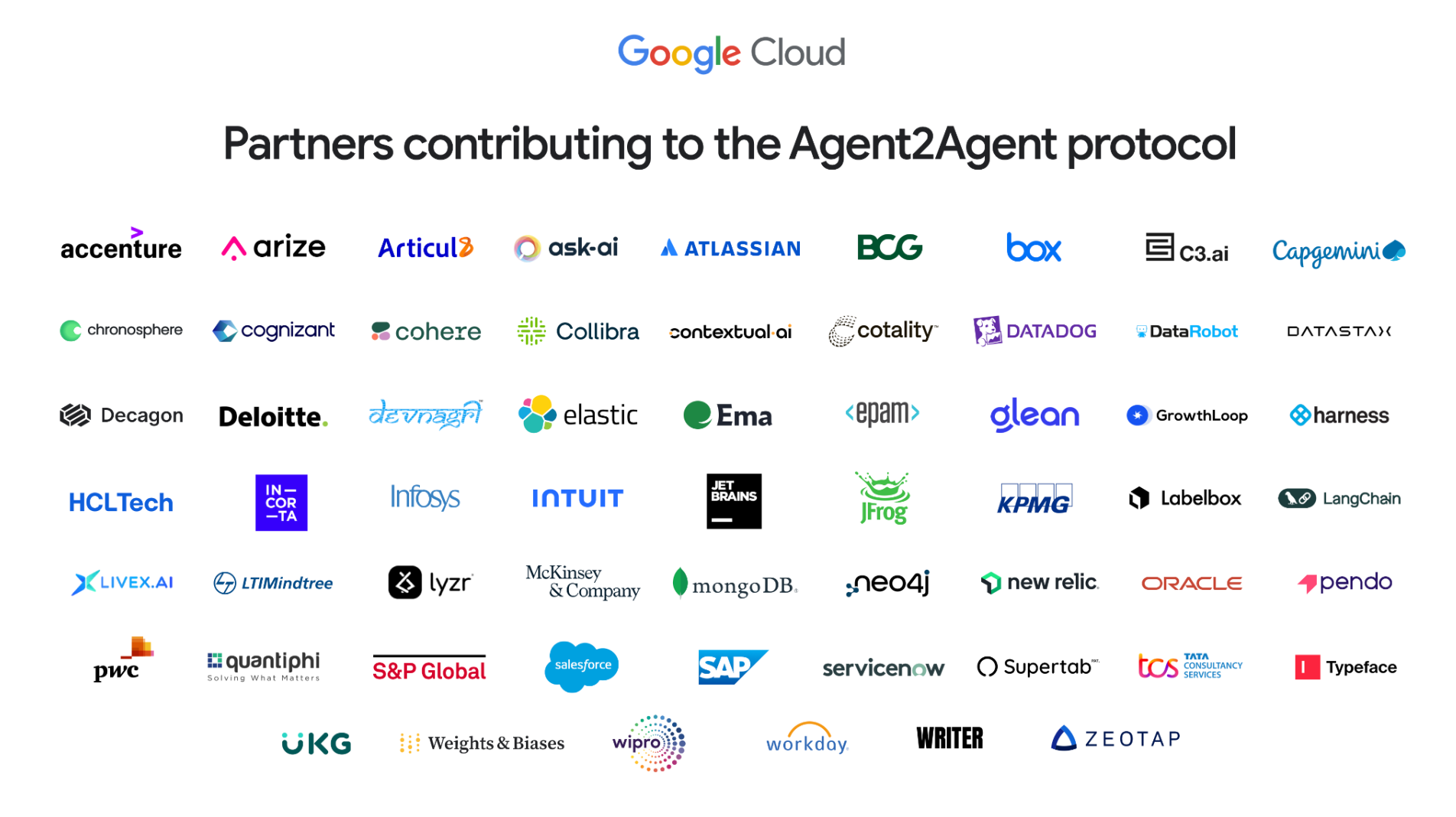
Open source communities continue to provide vital collaborative spaces to define emerging standards, ensuring the interoperability and extensibility for the next generation of technologies. In 2025, we worked with more than 50 partners on the Agent2Agent (A2A) protocol to enable AI agents to communicate with each other, securely exchange information, and coordinate actions on top of various enterprise platforms and applications. Within weeks of our initial announcement, Google donated the A2A project to the Linux Foundation as part of our long-standing commitment to develop "open, collaborative ecosystem – offering greater autonomy and multiplying productivity."

Google Cloud - Partners contributing to the Agent 2 Agent protocol - Accenture, Arize, Articul, ask-ai, Atlassian, BCG, Box, c3.ai, Capgemini, Chronosphere, Cognizant, Cohere, Colibra, Contextual.ai, Cotality, Datadog, and more

Launching tools with transparency

Open source licenses provide a framework for anyone to explore, test, fork and expand on our technologies. Over the last 15 years, Google has created more than 15,000 public repositories on GitHub. Today, Google continues to maintain more than 5,000 public repositories on GitHub, and more than 1,500 public repositories on Git-on-Borg. A quick look back to some highlights from our 2025 launches includes:

  • Gemma 3 – a collection of lightweight open models built from the same research and technology that powers our Gemini 2.0 models. They are designed to run directly on devices — from phones and laptops to workstations — helping developers create AI applications, wherever people need them. Since Gemma’s release in 2024, the Gemmaverse community has created more than 60,000 Gemma variants. We’ve continued work on this collection and in 2026 we released Gemma 4 under an Apache 2.0 license.
  • Agent Development Kit – an open-source framework and SDK designed to help developers build, compose, and run both conversational and non-conversational AI agents.

Adjusting our collective security practices

As the threat landscape evolves and accelerates in the AI era, we are working on novel solutions to mitigate vulnerabilities at scale and remove some of the burden from overloaded maintainers. In 2025, we introduced several critical security initiatives to support upstream open source projects:

  • CodeMender: An agent designed to be both reactive, instantly patching new vulnerabilities, and proactive, rewriting and securing existing code and eliminating entire classes of vulnerabilities in the process. In its first six months, we were able to upstream 72 security fixes to open source projects, including some as large as 4.5 million lines of code.
  • OSS Rebuild: A security initiative to prevent software supply chain attacks by verifying build provenance. It automates package rebuilding and semantically compares results to upstream artifacts to detect tampered code on registries like PyPI, npm, and Crates.io.
  • OSV-Scalibr: (Software Composition Analysis Library) the core engine for vulnerability scanning used internally and in OSV-Scanner.
  • Credential Scanning on deps.dev: A service (using Veles) that actively scans open-source packages on deps.dev for leaked GCP credentials to prevent account compromise.

Working together to sustain the contributor community

Beyond security contributions, we remain committed to providing financial support directly to projects and maintainers. In 2025, the Open Source Programs Office (OSPO) directed $2M in sponsorships and investments to more than 40 open source projects.

Google Summer of Code celebrated its 21st year of enabling open source organizations to find, mentor, and onboard new contributors, directly supporting 1,280 individuals to contribute to 185 organizations. Over its lifetime, the global program has connected more than 23,000 participants from 125 countries with over 1,000 open source organizations globally. Moving forward, we recognize the need to evolve our program structures to ensure they continue to effectively support maintainers in the AI era.

Evolving the way we work in open spaces

Respecting community norms and practices is fundamental to establishing and maintaining trust in open source communities. To ensure we remain supportive members of your community, we encourage projects to document preferred practices and policies in the wake of new technologies. As AI changes the way we work, we are continually evaluating how best to evolve the way we engage in open spaces to preserve, prepare and bolster the communities we depend on.

We are deeply grateful for the many individuals and organizations that have worked with us to create global technologies from which everyone can benefit. You can continue to learn more about our open source initiatives, ongoing programs, and new projects at opensource.google.

Appendix: About this data

This report features metrics provided by many teams and programs across Alphabet. In regards to the code and code-adjacent activities data, we wanted to share more details about the derivation of those metrics.

  • Data sources: These data represent the activities of Alphabet employees on public repositories hosted on GitHub and our internal production Git service Git-on-Borg. These sources represent a subset of open source activity currently tracked by Google OSPO.
  • Business and personal: Activity on GitHub reflects a mixture of Alphabet projects, third-party projects, experimental efforts, and personal projects. Our metrics report on all of the above unless otherwise specified.
  • Alphabet contributors: Please note that unless additional detail is specified, activity counts attributed to Alphabet open source contributors will include our full-time employees as well as our extended Alphabet community (temps, vendors, contractors, and interns). In 2025, full time employees at Alphabet represented more than 95% of our open source contributors.
  • GitHub Accounts: For counts of GitHub accounts not affiliated with Alphabet, we cannot assume that one account is equivalent to one person, as multiple accounts could be tied to one individual or bot account.
  • Active counts: Where possible, we will show ‘active users’ defined by logged activity (excluding ‘WatchEvent’) within a specified timeframe (a month, year, etc.) and ‘active repositories’ and ‘active projects’ as those that have enough activity to meet our internal active-project criteria and have not been archived.

Visual screenshots now included in Google Meet meeting notes

We’re improving the ‘Take notes for me’ feature in Google Meet by giving you the ability to automatically capture and include screenshots of presented content directly in the meeting notes document.

While meeting transcripts capture what is said, they often miss critical visual context, like content that was presented. Without these visuals, notes can lack necessary detail or even be confusing if a speaker refers to a chart or diagram without describing it out loud.


Getting started

  • Admins: You can configure this feature in the Admin console to either always allow screenshots of presented content or only allow them when a recording is enabled. Visit the Help Center to learn more.
  • End users: When you begin presenting in a meeting where notes are being taken, you will see a notification alerting you that Gemini may capture screenshots of your presentation to add to the notes. This feature can be disabled from the notes panel.

Rollout pace

Availability

  • Business: Business Standard and Plus
  • Enterprise: Enterprise Standard and Plus
  • Education: Google AI Pro for Education

Resources

Provide more clear, contextual feedback with timestamped comments in Google Drive videos

We are introducing timestamped comments for videos in Google Drive on the web. Users can now anchor comments to a specific time mark in a video, making video collaboration more direct, precise, and contextual.

When reviewing a video file, users can choose between adding a timestamped comment or a general file-level comment using a split button in the commenting interface.  Each timestamped comment generates a visual marker directly on the video player timeline. Clicking a marker automatically jumps to that point in the video and highlights the associated comment, allowing reviewers and video owners to navigate feedback without manually scrubbing through media files. Standard commenting capabilities—such as editing, resolving, replying, and mentioning colleagues with @ notifications—remain fully supported and integrated with time-anchored notes.

This feature streamlines cross-functional workflows by eliminating the need to track timecoded feedback in separate documents, chat threads, or emails. Teams producing demos, training videos, marketing content, or recorded presentations can now conduct precise, asynchronous reviews directly within Drive. While timestamped comments must be created on the web, mobile users viewing videos on iOS or Android will still see these entries formatted as standard file-level comments.

Getting started

  • Admins: This feature will be available by default for all users. There is no admin control for this feature.
  • End users: There is no end user setting for this feature. Visit the Help Center to learn more about commenting on videos.

Rollout pace

Availability

  • Available to all Google Workspace customers, Workspace Individual subscribers, and users with personal Google accounts

Resources